Yes, and Omega's own records show why. Omega's Vintage Database lists 123 of its references dated before 1980 as certified chronometers, and Omega's parts catalogues print about half of all parts for more than one calibre. A vintage Omega is only as good as the one in front of you, though, so check that the movement belongs in the case before you buy.
Quick answers
- Were vintage Omegas well made? Omega's Vintage Database lists 123 chronometer-certified references before 1980. 92 of them are Constellations.
- Can one still be serviced? Yes. Of the 5,775 parts Omega's GF 620 catalogues list in our database, 3,000 are printed for two or more calibres.
- Which is the safest buy? One whose movement matches its case reference. Omega's records give the right calibre for each reference, and our free lookup reads them.
- What goes wrong? Mismatched movements, swapped parts and misread part numbers. The factory paperwork catches all three.
Built to a standard: the chronometers
A certified chronometer passed an official timing test before it left the factory. Omega's Vintage Database lists 123 such references dated before 1980, out of 1,411 dated references in that span.
| Decade | References listed | Chronometer certified |
|---|---|---|
| 1940s | 185 | 16 |
| 1950s | 198 | 21 |
| 1960s | 471 | 51 |
| 1970s | 504 | 35 |
The Constellation carries most of them: 92 of the 123. The Seamaster has 17, and the De Ville and the Centenary have the rest with the unnamed references. The calibres behind them are the ones collectors know, led by the 712 in 14 references and the 561 and 564 in 29 between them, then the 751, the 1011 and the early 352 and 354.
A chronometer dial is also a reason to check the movement. A dial that says chronometer over a calibre that never was one is a swap. The free reference lookup gives the calibre Omega fitted to each reference, and our Constellation guide covers the line that carries most of them.
Built to be serviced: the shared parts
Omega built its calibres from a common stock of parts, and its GF 620 catalogues show it on every page. Of the 5,775 parts those catalogues list in our database, across 225 calibres, 3,000 are printed for two calibres or more and 1,067 for five or more.
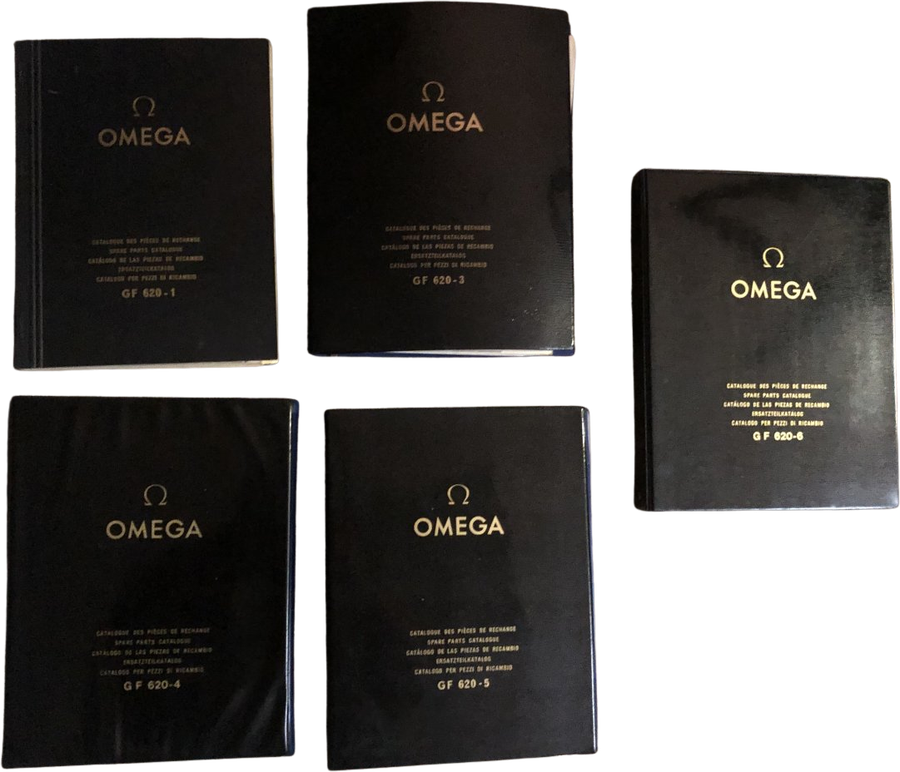
The most shared are the jewels and screws at the heart of the movement:
| Part number | Part | Calibres it is printed for |
|---|---|---|
| 4208 | Jewel for escape wheel, lower | 63 |
| 4209 | Jewel for pallet fork, upper and lower | 57 |
| 100.1342 | Cap jewels for balance, upper and lower | 49 |
| 2154 | Screw for stud for hairspring | 48 |
Whole calibres are built the same way. The automatic 455 of the 1950s prints 101 part numbers, and only 13 carry its own 455 prefix; the rest come from the 450 and other calibres. In Omega's 1960 appendix for the monocoque Seamaster calibres, one crown stem, 550.1150, is printed for ten calibres. Our model guides show it calibre by calibre: 80 of the 1030's 87 part numbers are also listed for the 1012, and 103 of the 752's 116 for the 565.
For an owner, that means a part listed for one calibre is often the right part for yours, under the same factory number. Our parts finder shows every calibre each number is printed for, with eBay searches ready.
Two cautions keep that honest. The catalogue records what Omega printed, not what a watchmaker has bench-tested, and watchmakers report some printed matches that need care in practice. And Omega sometimes changed a part without changing its number: winding pinion 300.1108 was redesigned and renumbered 330.1108 for later calibres, while older ones kept the old number. Match the number and the calibre, not the number alone.
What makes one a good buy
A good vintage Omega is a correct one. Five checks, each answered by Omega's own paperwork, separate a sound watch from a marriage of parts.
- The movement matches the reference. Read the reference inside the caseback and look it up. Omega's records give the calibre fitted to it, such as the 562 or 565 for the Seamaster 120 reference 166.0027. A different calibre means the movement was swapped.
- The dial matches the movement. A chronometer dial needs a chronometer calibre, and a date window needs a calendar calibre. Our free calibre lookup shows the designation line, where CAL marks a date.
- The metal matches the prefix. Omega's references carry a metal code: ST is stainless steel, BA is 18K solid yellow gold, BC is 18K white gold, CD is a gold cap on steel, and MD is gold-plated. A “solid gold” listing on an MD reference is wrong. Our weigh tool checks a gold case by weight.
- Replacement parts are named, not hidden. Service parts are normal on a watch this old, and the factory marks some of them. A bracelet clasp engraved 3000.000 is a service replacement, and De Ville and Constellation crowns were replaced by 42132 and 42134 when Omega changed their gaskets. Neither makes a watch fake; both belong in the description. How to authenticate covers the rest.
- Search under both calibre numbers. Omega renumbered some calibres in 1995, so the 861 became the 1861. Parts and sold prices turn up under both.
Can't open the back, or not sure what you're looking at? The US$75 Movement ID Report checks the calibre, reference, dial and metal against Omega's catalogues and the AWI fiche, and says whether the movement belongs in that case.
Questions owners ask
Is Omega a good watch brand?
For vintage watches, the factory record says yes: 123 chronometer references before 1980 in Omega's Vintage Database, and catalogues that print about half of all parts for more than one calibre. We work only with vintage Omegas, so we leave modern models to others.
What is my vintage Omega worth?
What the same reference, with its correct calibre, has actually sold for, not what sellers ask. Read the reference inside the caseback, check the calibre matches it with the free lookup, then compare sold listings for that reference.
Can I still get parts?
Search by the Omega part number, not a description, and check every calibre the part fits: a part listed for one calibre often fits others. The parts finder gives the factory number for each part and the calibres it fits, with eBay searches ready to go.
Which Omega do I have?
Read the reference number inside the caseback, such as 166.010, and type it into the free reference lookup: Omega's own records give the model, the years and the calibre. The calibre number is stamped on the movement itself, so the two should agree. If they don't, or you can't open the case, the US$75 Movement ID Report checks it from photos.
Is there a service manual for my Omega?
Not by that name. Omega printed parts catalogues and, for some calibres, technical guides. Journal No. 2 explains what each holds, and Journal No. 3 covers winding a Seamaster.
Not sure what you have? Start with the free reference lookup, serial lookup and calibre lookup. For it in writing, checked against the catalogues, the Movement ID report is US$75, and nothing to pay until I confirm the photos can answer it.