Omega did not print a book called a service manual for its vintage calibres. What the factory printed for watchmakers was a spare parts catalogue, GF 620, and technical guides for some calibres; from 1970 those guides set out the full order of assembly. We work from both, and between them they answer more than most owners expect.
Quick answers
- Is there a service manual for my calibre? Not by that name. There is a parts list in GF 620, and for some calibres a technical guide. From 1970 on, those guides give the full order of assembly.
- What does a technical guide cover? Specifications, oiling and special parts. The 1950s–60s guides cover only special assemblies, not the whole take-apart; guides from 1970 on give the full order of assembly.
- Where are my calibre's part numbers? In GF 620, listed by calibre. Our free calibre lookup reads from it.
- What order do the parts come out in? Our films show each calibre taken apart and put back together in bench order, with the factory number on every part.
What Omega actually printed
Three kinds of factory paperwork matter for a vintage Omega movement. Only the technical guides from 1970 on give a full step-by-step order.
GF 620, the spare parts catalogue. Black binders printed in five languages: French, English, Spanish, German and Italian. Each calibre has its own section listing every spare part with its factory number. We hold volumes 620-1, 620-3, 620-4 and 620-5, with 620-6 arriving this month. Volume 620-2 is still on our wanted list.

Technical guides. Omega issued these for some calibres, not all. The ones on our shelf include calibre 610 (Technical Guide No. 17), the 860, 861, 910 and 930 chronographs, the 863, the 980, the 1010 to 1022 family, the 1040, and the 1002 in the Seamaster 600 Professional (Technical Guide No. 47).
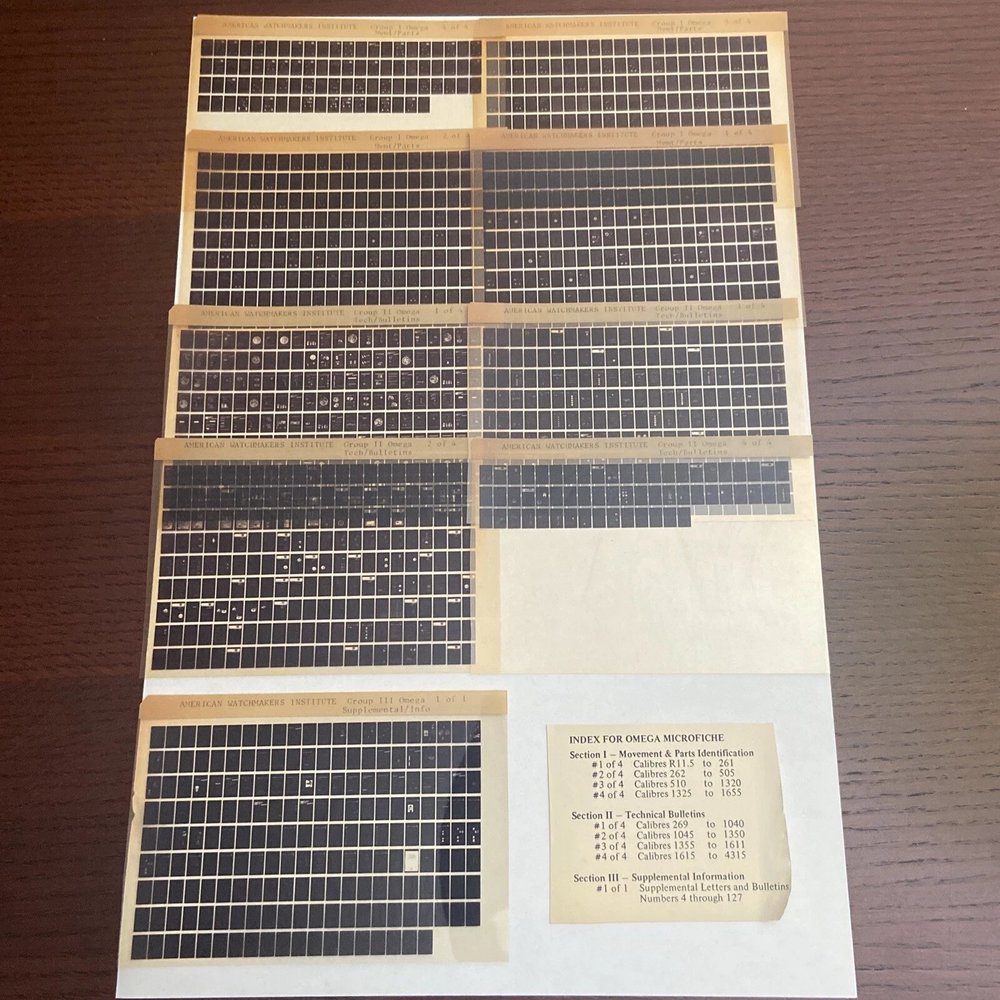
The AWI Omega microfiche. The American Watchmakers Institute put Omega's paperwork on nine fiche sheets in three sections: movement and parts identification (calibres R11.5 to 1655), technical bulletins (calibres 269 to 4315), and supplemental letters and bulletins (numbers 4 to 127). Our set joins the shelf this month. The free coverage checker shows which sheet covers your calibre.
Every part from these books goes into one database. As of 5 October 2026 it holds more than 5,900 parts and 16,900 part-to-calibre fitments across 227 calibres.
What a technical guide holds, and what it doesn't
The older technical guides, from the 1950s and 1960s, give a trained watchmaker the facts particular to one calibre. They assume the take-apart is already known and walk through only what is new, such as the 591's automatic unit or the 540's Gyrocap jewel settings.
What you get:
- Specifications. For calibre 620, the guide gives a lift angle of 52° and a power reserve of 48 hours. Those are the numbers a timing machine needs.
- Oiling. Which points take oil, and which oil.
- Special parts and cautions. The parts unique to that calibre, and warnings where they matter. The calibre 1040 guide marks switch screw 2472 "Do not unscrew." The 540 guide says to clean its Gyrocap jewel settings without removing them, because each is adjusted at the factory.
What the older guides leave out: the order the whole movement comes apart, which screw goes in which hole, or which screws turn the wrong way. That gap is why we film every calibre in bench order, number every screw on screen, and show left-hand (reverse-thread) screws in red.
Later guides go further. From 1970, Omega's guides set out the full order of assembly: the 1970 guide for the 860, 861, 910 and 930 chronographs, and the 1972 guides for the 980, the 1010 to 1022 family and the 1040. Our 1040 film follows that printed order. The 1990s guides, such as those for calibres 651 and 721, add an exploded drawing with the parts listed in order of assembly, an oiling chart that names each oil, and hand-fitting heights.
Two traps the factory paperwork shows
Calibres that changed number. An Omega service circular from 2004 records that some calibres were renumbered in 1995. Calibre 861 became 1861, 1150 became 1151, and 1155 became 1152. A parts search under only one of those numbers misses the listings under the other, so search both.
Misprints in the books. Factory paperwork has typos too. Technical Guide No. 17, for calibre 610, prints the friction spring as 610.1255. The correct number is 600.1255. Order the printed number and you can come up empty. Where we find a misprint, the database carries the correct number and a note.
How to find the paperwork for your calibre
- Find the calibre number. It is stamped on the movement under the caseback. If the back is still on, start with the case reference inside it or the serial number, using our free reference and serial lookups.
- Look up the parts. Our free calibre lookup lists the GF 620 parts for that calibre, each with its factory number.
- Watch it come apart. If we have filmed your calibre, the film shows every part in bench order with its number on screen. Watch it before you open your own watch.
- Not sure what you have? The US$75 Movement ID Report checks your calibre, case reference, dial and metal against Omega's GF 620 catalogues and the AWI fiche, and tells you whether the movement belongs in that case.
If the books don't cover your calibre, we say so. We never guess a part number.
Questions owners ask
Is GF 620 a service manual?
No. It is Omega's spare parts catalogue. It tells you what every part is and its factory number, calibre by calibre. It does not tell you how to take the movement apart.
Does every vintage calibre have a technical guide?
No. Omega issued them for some calibres. Send us your calibre number and we'll tell you what the factory printed for it.
Does a technical guide show me how to strip my watch?
Not the 1950s–60s ones, beyond one special assembly here and there; they cover specifications, oiling and special parts. From 1970 on, the guides give the full order of assembly, such as the 1972 guide for the 1040, and the 1990s guides, such as the 721's, add an exploded drawing. For any calibre we've filmed, watch the film for yours.
What is the AWI microfiche?
The American Watchmakers Institute's copy of Omega's paperwork on nine fiche sheets: parts identification, technical bulletins, and supplemental letters and bulletins.
Why does the same movement show up under two numbers?
Omega renumbered some calibres in 1995. The 861 became the 1861, for example. Check parts under both numbers.
I lost a screw. How do I find the right one?
Find your calibre in the free lookup. Every screw is listed with its factory number, and our films show where each one goes.
Not sure what you have? Start with the free reference lookup, serial lookup and calibre lookup. For it in writing, checked against the catalogues, the Movement ID report is US$75, and nothing to pay until I confirm the photos can answer it.