Model guides
Vintage Omega watches: identify any model
Omega made millions of watches between the late 1940s and the 1970s, under a handful of names that were reused, split and revived. The name on the dial gets you to the right family. Three numbers on the watch itself tell you exactly which watch it is, how old it is, and whether its parts started life together. This page covers both.
Find one on eBay
Live listings and real sold prices for the vintage models on this page.
Which model is whichAffiliate links: Watch Breaker may earn a small commission. Opens in a new tab.
Start with the name on the dial
Each of these has its own guide with the calibres, the case references, dating and prices. Pick yours.
| Model | Made | What it is | Calibres | Guide |
|---|---|---|---|---|
| Seamaster | 1948 on | Omega's everyday water-resistant line, from dress watches to divers | 342–355 bumpers, 500 series, 550/560 series, 1000 series | Seamaster guide |
| Constellation | 1952 on | The chronometer line, with the observatory on the back | 354, 505, 551/561, 564/751, 1001/1011/1021 | Constellation guide |
| Genève | 1953; entry line from c. 1967 | Two different watches under one name, priced a world apart | 552/565, 601/613, 1010–1022, 1030 | Genève guide |
| Seamaster De Ville | 1960–1967 | The slim dress Seamaster in a one-piece case | 552, 560–565, 600 family | De Ville guide |
| Speedmaster | 1957 on | The chronograph, worn on the Moon in 1969 | 321, then 861 from 1968 | Speedmaster guide |
Other vintage names you will see
Most of these are a Seamaster, a Genève or a movement rather than a line of their own. Here is where each one is covered.
| Name on the dial or in the listing | What it is | Where to look |
|---|---|---|
| Seamaster 300 | The dive watch: CK 2913 from 1957, later 165.024 | Seamaster references |
| Ploprof | The 600 m diver, 166.077, calibre 1002 | Ploprof guide |
| Seamaster 120 | The 120-metre Seamaster, 1966 to 1979 | Seamaster 120 guide |
| Cosmic, Cosmic 2000 | The everyday Seamaster automatic, 1962 to the mid-1970s, in two generations | Cosmic guide |
| Speedmaster Mark II–IV, 125, Speedsonic | The 1970s Speedmasters: barrel cases, automatics and the tuning-fork chronograph | Speedmaster references |
| Dynamic | The oval case with the integrated strap, from 1968 | Genève guide |
| Chronostop | The single-pusher stopwatch, about 1966–1970, calibre 865 or 920 | Genève guide |
| Railmaster | The antimagnetic watch, from 1957 | Reference lookup |
| Flightmaster | The pilot's chronograph, 1969 to 1973, calibre 910 or 911 | Flightmaster guide |
| Bumper automatic | Not a model: the half-rotor movement of 1948–1955, in Seamasters and Constellations | Seamaster calibres |
| Electric and quartz | Tuning-fork and early quartz Omegas of the 1970s | Genève guide |
The three numbers that identify any Omega
A dial can be repainted and a listing can be wrong. These three are stamped into the metal, and between them they settle what the watch is.
Stamped on the movement bridge, with the caseback off. It gives the movement, its era and its parts.
Calibre lookupStamped inside the caseback. It gives the model, the metal and the calibres Omega fitted.
Reference lookupEngraved on the movement. It gives the year the movement was made.
Serial lookupWhen the three agree, you have a correct watch. When they don't (a 1970s calibre in a 1960s case, or a serial ten years away from the reference), you have a marriage, and it is worth a lot less. For the parts around the movement, the hands lookup and the crystal lookup work from the same case reference.
Is it gold?
Omega sold the same reference in steel, gold cap, gold plate and solid gold, and the solid ones are the minority. The prefix inside the back is the quickest test: CK and ST are steel, KO is gold cap, MD is gold-plated, OT and BA are 18k. A solid case also carries a 750 or 585 stamp. Gold or plated goes through every mark, and Weigh your Omega tells you how much gold a solid case holds.
Is your Omega all original?
The reference, the calibre and the dial have to agree. Six photos and the weight, and I check them against Omega's own records and put it in writing. Nothing to pay until I confirm the photos can answer it.
What it's worth
Every vintage Omega has three values: as a whole watch, as parts, and as gold if the case is solid. A correct steel automatic from the 1950s or 1960s with its original dial sells in the high hundreds to low thousands of dollars. A redialed or married one falls toward parts value, which is often still a few hundred. What's my Omega worth? works through all three, and Where to sell it covers getting the best price.
Is it real, and is it original?
Outright fakes exist, but the bigger problem with vintage Omegas is honest watches that aren't all original: a repainted dial, replacement hands, or a movement from a different watch. Is it real? shows what to check and the photos to ask a seller for.
Where the data comes from
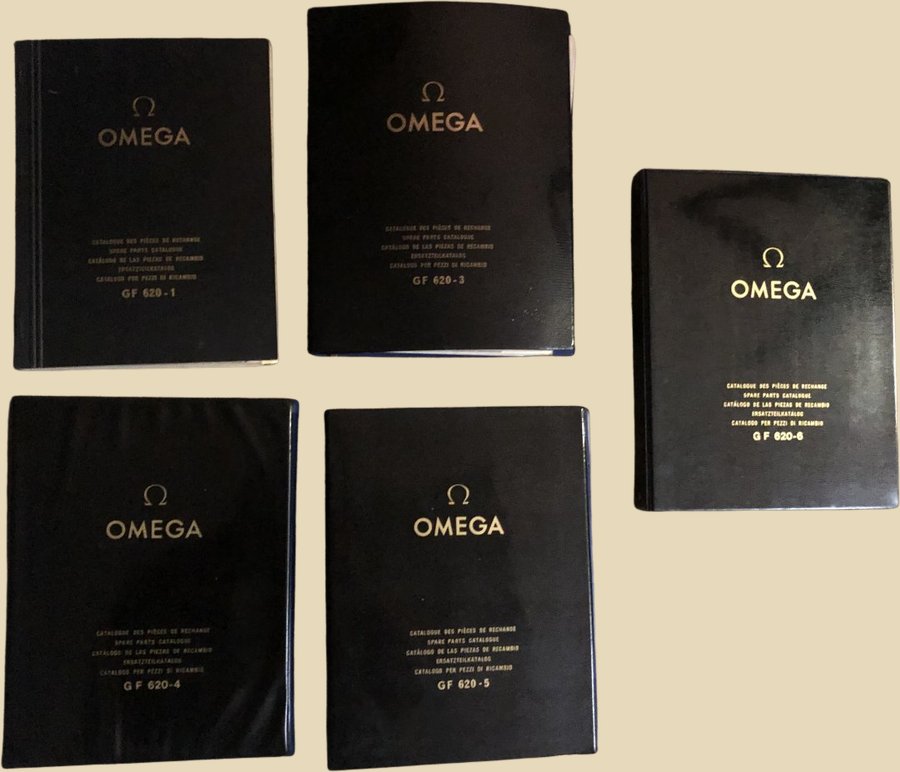
The calibre data on these pages is transcribed from Omega's own GF 620 spare-parts catalogues and the AWI Omega microfiche, which are the same sources behind every report. How a report is made shows the process.
Six photographs and the weight, and I put it in writing: calibre confirmed against its factory sheet, case checked against Omega's own case data, serial dated, dial judged, three honest values. Within a day. US$75, and nothing to pay until I confirm the photos can answer it.
Questions people ask
How do I identify my vintage Omega?
Take the caseback off and read the calibre number stamped on the movement bridge, then read the case reference stamped inside the back. The calibre tells you the movement and its era, the reference tells you the model and the metal, and the serial on the movement dates it. The model guides and lookups on this page cover all three.
How old is my Omega?
The serial number engraved on the movement dates it. Run it through the serial number lookup to get the year band. The calibre gives a cross-check: a bumper automatic is 1948 to 1955, a 550/560-series is about 1958 to 1969, and a 1000-series is 1969 or later.
Are vintage Omega watches worth anything?
Yes. A correct steel automatic from the 1950s or 1960s with its original dial typically sells in the high hundreds to low thousands of US dollars. Solid gold adds the metal value. A redialed or married watch drops toward parts value, which is still often a few hundred dollars.
Is my vintage Omega solid gold?
Only if there is a fineness stamp such as 750 (18k) or 585 (14k) inside the caseback or under the lugs. The case reference prefix tells you too: CK and ST are steel, KO is gold cap, MD is gold-plated, and OT and BA are 18k gold. No stamp means it is not solid, however it looks.
Watch Breaker is an independent identification specialist and parts dealer and is not affiliated with, endorsed by or connected to Omega SA or the Swatch Group. Omega is a trademark of Omega SA. Specifications are transcribed from printed catalogues; reference pairings are community-graded unless stated. Terms.